Calm in the Chaos: How Young Footballers Master Decision-Making Under Pressure
Football is less a game of physical tricks and more a rapid-fire sequence of split-second decisions. Over ninety minutes, a player is confronted with hundreds of choices: Do I take this defender on or play backward? Do I shoot, hold up possession, or clip a pass into the pocket?
Having brilliant technical ability means very little if a player repeatedly picks the wrong option under pressure. While solid technique provides the tools to execute a play, game intelligence is what tells a player which tool to use—and precisely when to use it.
In junior football across Perth, the key to building intelligent, fearless players isn't giving them more rigid instructions; it’s putting them in environments where they have to think for themselves when the heat is turned up.
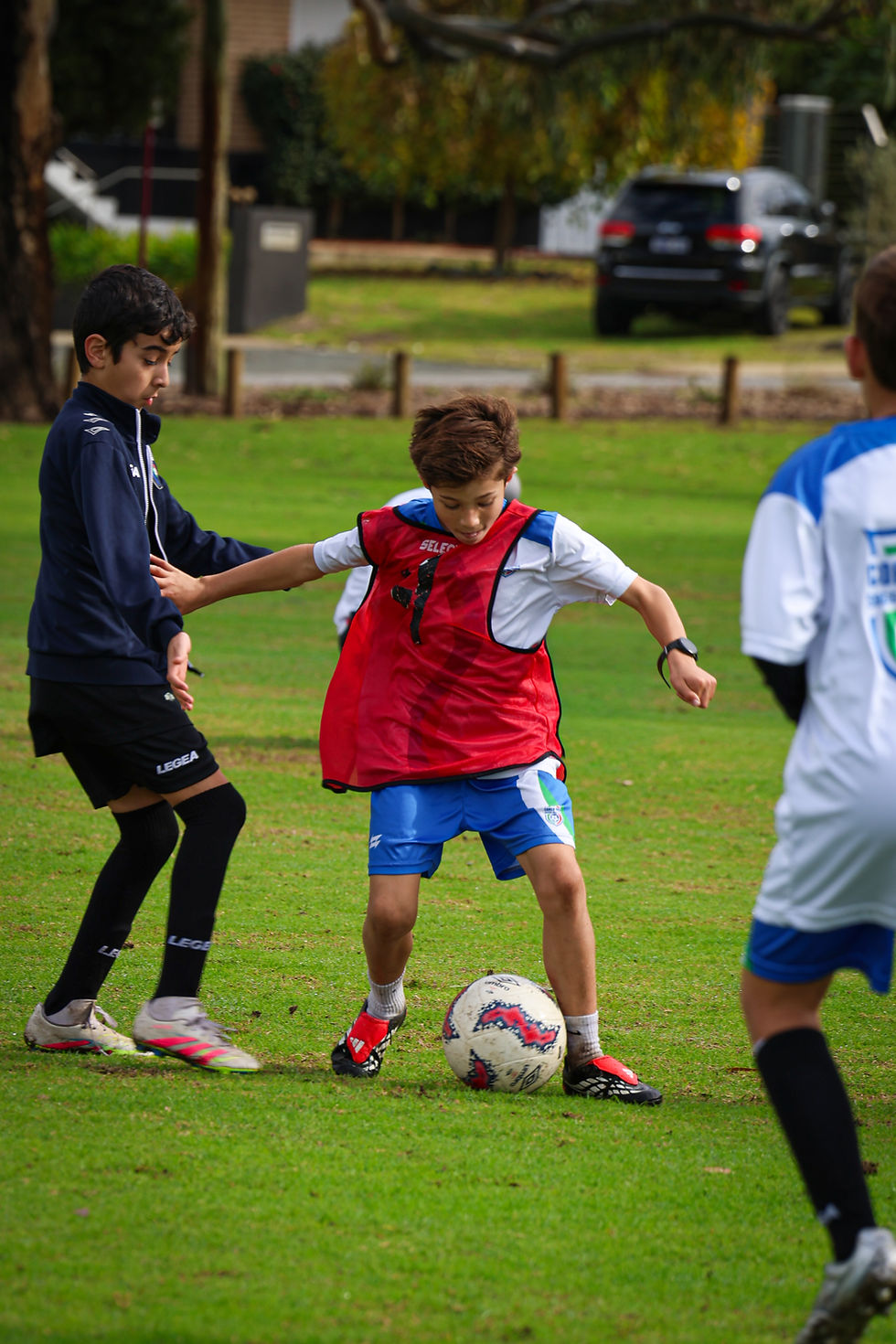
Why Pressure Completely Changes the Game
We've all watched kids look like absolute superstars in unopposed drills—weaving smoothly around cones or hitting stationary target nets with ease. Yet, put that exact same player in a high-stakes match with a defender gunning for their throat, and their game completely breaks down.
That happens because pressure steals time and space. When an opponent closes in, a young player's brain gets overloaded with sensory input: tracking the ball, gauging defender distance, and managing their physical balance all at once.
To bridge this gap, training shouldn't just be about repeating physical movements; it must gradually introduce cognitive pressure:
Active opposition: Moving away from static cone drills to drills with live defenders.
Constrained spaces: Shrinking the playing area to force faster reaction times.
Numerical overloads: Using 2v1 or 3v2 scenarios to highlight immediate passing options.
Directional targets: Ensuring drills have a clear direction so players learn to play forward under stress.
Scanning: The Secret to Buying Extra Time
The best decision-makers on the pitch rarely look panicked, even in tight spaces. That isn't because they run faster—it's because they gather information before the ball arrives.
Scanning (checking shoulders before receiving) acts like a cheat code for young players. By taking a quick head-turn prior to making contact with the ball, a player already knows:
Where the nearest defender is pressing from.
Which teammate has space.
Whether they can turn on their back foot or need to shield possession.
A player who scans arrives at the ball with a plan. A player who forgets to look arrives at the ball in a panic, leaving their decision to pure chance.
Harnessing the Power of Small-Sided Scenarios
You cannot lecture a young player into being a great decision-maker; game intelligence is learned through real-time experience.
Small-sided games (1v1s, 2v1s, 3v3s) are the most effective tool for accelerating this learning process. Because pitch sizes are compressed and player numbers are low, every child is constantly involved. If a player holds onto the ball a second too long in a 2v1, the defender intercepts it immediately. The feedback is instant, tangible, and far more powerful than a coach shouting instructions from the sideline.
Through high repetition in small-sided play, kids naturally begin to recognise visual patterns—learning when to commit a defender, when to release a pass, and how to exploit open space.
Why Mistakes Are Essential to Good Choices
A young player who is terrified of making an error will always choose the safest, most boring option on the pitch—usually kicking the ball out of bounds or passing backward under zero threat.
Building real decision-making confidence requires a training pitch where mistakes are treated as data, not failures. When coaches ask guiding questions ("What else did you see there?" or "What was another option?") rather than scolding errors, players develop true problem-solving independence. They stop looking to the bench for permission and start trusting their own eyes.
Accelerating Game Intelligence with Coach Nick 9
While team sessions must balance overall squad tactics and match setup, 1-on-1 and small-group training at Coach Nick 9 focuses directly on individual decision-making. We place developing Perth players into high-touch, realistic match scenarios where they get the immediate feedback, repetition, and confidence required to make sharp, composed choices when match day pressure hits.


