Stretching vs. Mobility: What Young Perth Footballers Actually Need
TL;DR: While stretching and mobility sound identical, they serve entirely different purposes on the pitch. Stretching lengthens passive muscles to relieve tightness, whereas mobility is the active ability to move a joint smoothly through a full range of motion with absolute strength and control. Young footballers require a deliberate balance of both to maximise agility and prevent injury.
Mobility (Before Practice): Active movements that prime the joints for explosive changes of direction.
Stretching (After Practice): Relaxing protocols that reset tight muscles and kickstart recovery.
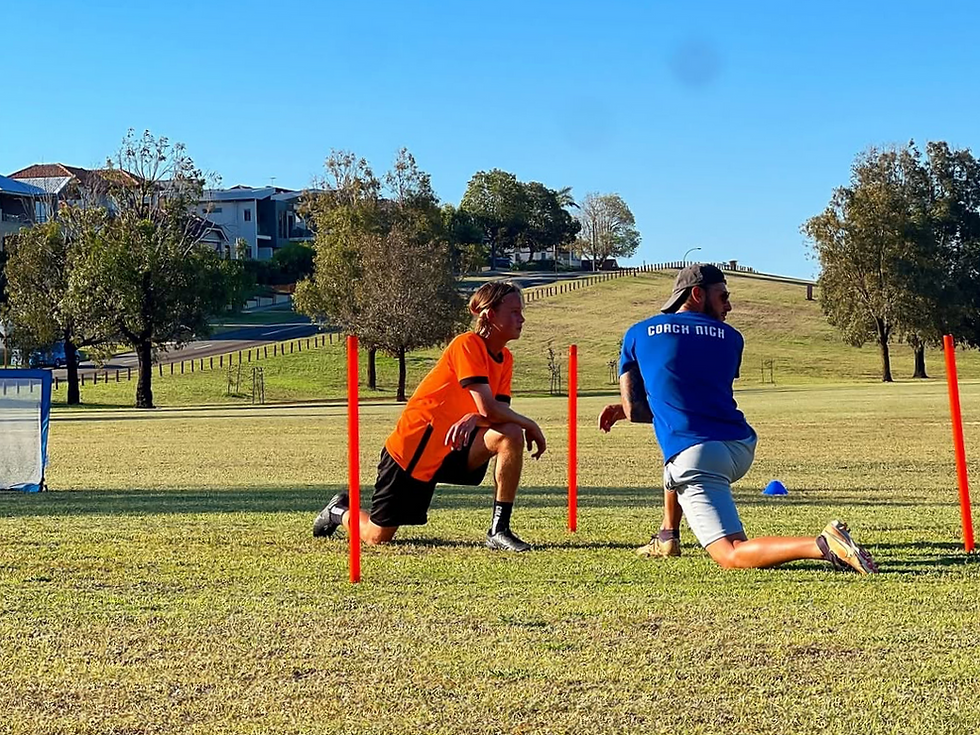
Breaking Down the Difference: Flexibility vs. Control
To help your child move efficiently, we have to separate these two concepts. A simple way to look at it is the difference between passive length and active strength:
Stretching (Flexibility): This is purely about how far a muscle can be lengthened. For example, if your child sits on the grass and reaches for their toes to stretch their hamstrings, they are demonstrating flexibility.
Mobility: This is about controlled movement through a joint. If your child can sprint, stop suddenly, open their hips to intercept a pass, and change direction smoothly without losing balance or straining a muscle, they have good mobility.
Flexibility is a component of mobility, but flexibility without control is highly dangerous on the football pitch. A child can be incredibly flexible but still have poor mobility if their nervous system cannot control that range of motion during a match.
Why Both Matter for Growing Athletes
During adolescent growth spurts, a young player's bones frequently grow faster than their muscles and tendons. This creates a natural tightness, particularly around the hips, hamstrings, and calves.
Without a structured approach to movement quality, this tightness rapidly leads to a drop in performance and a rise in common youth soccer issues like shin splints or heel pain.
The Power of Mobility
Mobility is what gives a player their "reactive agility". It allows a midfielder to twist out of a tight space or a defender to drop their hips and jockey an attacker. Good mobility ensures that forces from running and kicking are distributed evenly across the muscles rather than overloading growing knee and ankle joints.
The Power of Stretching
Stretching acts as the physical reset switch after intense training or a hard match. It helps desensitise the nervous system, reduces post-game muscular stiffness, and maintains long-term muscle health so your child doesn't turn up to their next session feeling heavy-legged and rigid.
The Weekly Routine: When to Use Each Tool
Using the wrong protocol at the wrong time can actively hurt your child's performance. For instance, holding deep, static stretches right before a game actually relaxes the muscles too much, reducing their explosive sprinting power.
Timing | The Focus | Recommended Movements |
Pre-Training / Pre-Match | Dynamic Mobility | Leg swings, open/close the gate hip rotations, lunges with a twist, and high knees. These wake up the nervous system and lubricate the joints. |
Post-Training / Post-Match | Static Stretching | Long, relaxed holds (20-30 seconds) focusing on the hamstrings, hip flexors, calves, and groin. This tells the body it is time to recover. |
Key Trouble Areas for Young Footballers
When monitoring your child's physical development, focus heavily on these five high-traffic zones:
The Hips: Crucial for sprinting power and kicking mechanics. Tight hips drastically shorten a player's stride.
The Ankles: Necessary for absorbing shock when landing or changing direction on hard Perth surfaces.
The Hamstrings: Frequently tight during growth spurts; poor length increases the risk of lower back strains.
The Groin: Under immense stress during sideways movements and long-range passing.
The Lower Back: Often overworks to compensate for stiff hips or weak core stability.
The Bottom Line
To excel in competitive environments, technical skill alone isn't enough--a player must have the movement mechanics to back it up.
Stop treating warm-ups as an afterthought. Teach your child that active mobility before they touch a ball primes them for performance, while dedicated stretching afterwards preserves their body for the rest of the season.

